
lessaignantes_jean-pierrebekolo
Hannah Brown presents 'Les Saignantes' (2005) at OSC x PAR-Projects on June 17 at 7:00pm

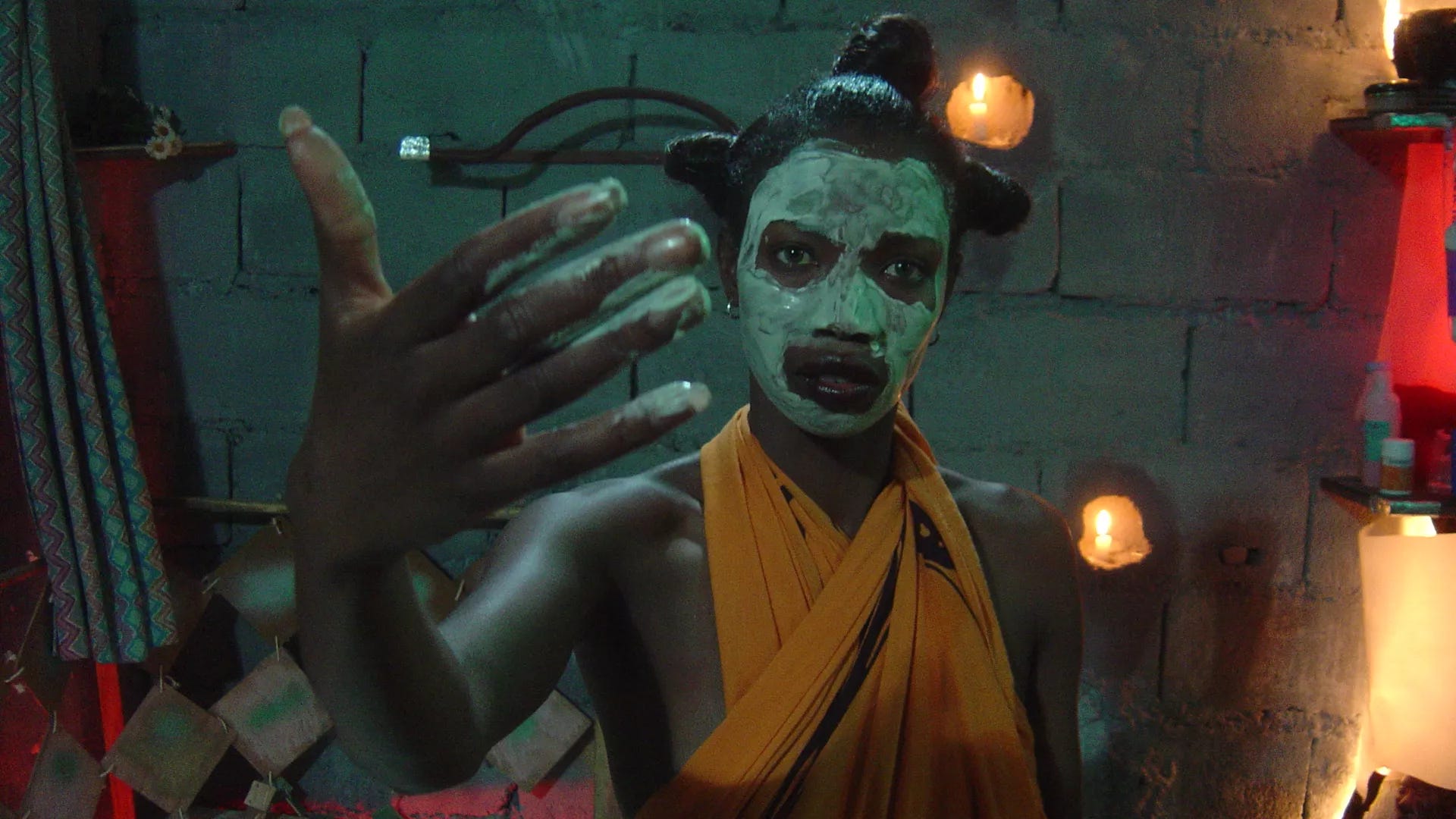
Hannah Brown is an art historian and blue portal enjoyer who studies trash and garbage and who loves when the images move on screen. Their program ‘Thresholding_video_vision_virus’ screens Tuesday nights in June (7pm, free) at PAR-Projects (1646 Hoffner St., Cincinnati).
There is a corpse in Majolie’s bed. Rifling through the SGCC’s wallet, she is aghast when she reads his date of birth “1939 … What is a granddaddy like you doing with a “bloodette” like me?” Majolie is disgusted, and rightfully so, stomping on his wallet (men can be reduced to a thing like that), the kind of crash out which is the only reasonable response to ongoing patriarchal violence. In a scene which is both slapstick and hurting she asks the off-screen corpse “Didn’t you see anyone else?” The abject experience of being lusted after by some hubrissed old bag transcends time, space, and language, but it also serves as a succinct representation of the ongoing corruption within Cameroon’s government, highlighting the centrality of women’s bodies to political power.
Les Saignantes levels a trance. Made after an eight-year hiatus, Cameroonian director Jean-Pierre Bekolo’s third feature-film serves as a kind of cautionary vision, figuring an ambiguous African country circa 2025 as an intertitled underworld navigated by thresholding-psychic-vampire-sex-workers Majolie and Chouchou. Bekolo routinely categorizes his work as being made from a place rather than for an audience, inscribing that which is against ordinary language in hypnotic rhythm, stuttering bodies, repetition with difference. He describes Les Saignantes (The Bloodettes, The Bloodiest, or Those Who Bleed) as belonging to an “impossible genre” – science-fiction in a place without future, horror where death and decay are celebrated. What happens if genre conventions are illegible in certain contexts? What residue remains?
It’s funny, Bekolo notes that he developed the film at Duke University … something beautiful at work in Durham, North Carolina … who knew <3 Often, criticism or scholarship on the film (which is small but not insignificant) references the “low budget” qualities of the film, but I wasn’t able to locate the exact budget (to be fair I could have tried harder), in a Screen Slate interview (answering a question about working with minimal funds) he notes that one of his more recent films Le President was made with a few thousand dollars and describes the excitement of receiving a grant (and not being beholden to a studio) for Les Saignantes as being “like Christmas”. An article on the history of Cameroonian cinema reports that he received an advance on his CNC earnings to finance the film. Regardless, the film was shot on digital, and later kinescoped in order to present a 35 mm copy to FESPACO (Panafrican Film and Television Festival of Ouagadougou, Festival panafricain du cinéma et de la télévision de Ouagadougou). Bekolo spent a year in the editing room, attuning to a particular rhythm:
“From 2005 to 2009, I was busy with that one film. Touring, but I also mean busy as in I was exhausted. My mother had passed away. I was in the editing room for a full year by myself. I also did it because I love editing and I didn’t want anybody to touch my film. Someone needed to kick me out of that room, but only if they had the strength to do it. That’s what’s great about making films—the moment when everybody is doing what he loves. As an editor, it was great to be able to do things instead of talking about them. Everything else in filmmaking is so verbal. I was trying to push the film to the limits—a trance object, a film that’s like voodoo.”1 Trance object trance object trance object <3
Simultaneously hopeful and bitter, Les Saignantes refers to a pre-colonial practice, mevoungou, as neo-archaic-cyberpunk-magic-tech, and sees material change as mediated by women (very Donna Haraway “Why should our bodies end at the skin?”). Briefly, the Mevoungou is a pre-colonial ritual and a secret society performed and constituted by women (forbidden to men). According to Beti cosmology, the Mevoungou rituals benefit men and women, settling the gamut from interpersonal disputes to droughts or famine. The society is based around the cult of the evu, a gland located within women’s uteruses which embodies good and evil. The rituals are divided into public and private elements (legible and illegible hehe), involving a kind of purification and subsequent change. (There is debate over what the rituals actually consist of, but it does seem to involve clowning on men <3) Naminata Diabate summarizes it as such: “Overall, the ritual consists in establishing a communion among the different entities: the package, the clitoris of the Mother of Mevoungou, and clitorises of other participants. Whereas modernity and its attendant institutions pathologize women’s bodies, Beti cosmology venerates them for their spiritual and healing dimensions.” Because the Mevoungou was abolished along with other indigenous Beti rituals by nineteenth-century German missionaries,2 there is little scholarship on it (for example, if you enter “Mevoungou” into JSTOR’s search bar it will populate ten results, my university’s library data base came up with two articles and two book). As such, Bekolo, himself a Beti, learned about the society and ritual through the work of French anthropologist Philippe Laburthe-Tolra.3 During a Q&A following a screening of Les Saignantes at the 2024 African Film Festival, Bekolo described the Mevoungou as a generative force, a kind of technology “And I kind of felt like the way things were going in Cameroon …maybe it’s time to call for a Mevoungou … So I didn’t know much about it. I read about it and I decided to use it because we tend to use African traditions in a funny way. But I want to put it like in the future and not in the past. Not like something that is kind of holding us back and something that could really get us forward.”4
As a caveat, I’ll note that the centrality of women to material change is empowering, but also risks setting a kind of good/bad binary where women are imbued with a kind of infantilizing goodness and flattening girls to metaphors. That being said, I don’t think the film engages, so much, in essentializing, nor does it suggest that kind of easy resolution, instead arguing repeatedly for collective action. And, at the end of the day, when beautiful women are on screen and one of them pisses standing up it just has to be feminist (I don’t make the rules).
I want to go back to the piss, I want to talk about decay and excrement and semiotics. After studying physics and chemistry at the University of Yaoundé, Bekolo studied at the Institut National de l’Audiovisuel in Paris under French theorist Christian Metz from 1988-1990. I’m not really sure what Bekolo’s relationship to semiotics or to Metz’s work is, nor am I a Metz scholar (with peace and love it is all very very dry to me). I wanted to contextualize the theory, but I changed my mind. It’s about the irreconcilable tension anyway (which Metz, I think, was preoccupied with resolving) and its sticky residue.5 Semiotics is always kind of catching up to magic and rituals, to the way utterances and gestures, structures and patterns create conditions through which meaning is generated. But I do think, maybe, there is a kind of transposing of that tension between the imaginary and the symbolic in Les Saignantes what cinema can and can’t say, what a body can or can’t do, explicitly and implicitly – especially in the use of the Mevoungou, an invisible force, generated by a set of conditions, which traditionally materializes in the clitoris and, in Les Saignantes, is translated as manifesting within mirrored reflections, the time-collapse within a montage, stuttering rhythm, a hanging moon. Anyway. Derrida gave a series of lectures on cannibalism between 1990 and 1991. He theorized that, “a residue resides in all things that will not be homogenized or even formalized, a residue that refuses every in-formation… there is an incessant inversion by which filth comes to serve as the foundation of the world … it is transcendent reality, or God.”6 Nourishment promises excrement, as does transformation. Try as they might, Derrida’s cannibal can never fully interiorize the other, and neither can anyone else. Transformation always results in excess, in that which must be discarded, in that which cannot be invisibly incorporated, in that which insists on its materiality. I guess that’s why they had to go and invent transubstantiation. In the ghost of Cameroon’s future, decay interrupts the narrative of inherent patriarchal power, maggots on every dinner table like fruit-dishes. Girls who refuse to die in a society that insists on killing them are residue too. There’s something there with the digital, and with cinema in general, but I don’t feel like doing math just yet. I think it suffices to say that transubstantiation in ritual, in Les Saignantes, illustrates the mass of paradoxes that confuse the artificial delineations duality demands.7 Divinity is material and immaterial, constant and (re)translated, one and multiple. Bekolo’s references to cannibalism and vampirism (and their representation within a disorienting narrative, frames which bleed into and skip back and forth between one another, figures that catch up to themselves), like Veronica’s veil (vernicle images), enshrines fraught negotiations with stability, situates waste as a mediator of memory, and highlights bodily processes. The taboo and the divine operate on flip sides of the same axis — a Holy Face can be excrement and an image.8 The image of Majolie pissing in the street, head flung back like a werewolf, makes legible a force beyond language and revels in the stubborn materiality of that which cannot be integrated seamlessly (here bodily processes, corporeal evidence of transformation and mutation). As Derrida has it, “excrement, like all the rest, comes first.”9
Like, but not.
Like, Takashi Miike’s Visitor Q dropped a toaster in the bathtub and speed-ran Grand Theft Auto: Vice City. Like, Twin Peaks: The Return was repeatedly hit over the head with a Limited Too mannequin and, spell-bound, grew three blue-green heads casting every image that ever moved lockjawed open like Cerberus when Orpheus passed over hell’s threshold. Like, Eurydice came after herself and lived doubly, incarnating what Young Thug put perfectly in July of 2017, “I hate when GIRLS die.”
Naminata Diabate, “Re-Imagining West African Women’s Sexuality,” in Development, Modernism and Modernity in Africa (Routledge, 2012), 167.
Naminata Diabate, “Film as an Instrumental and Interpretive Lens” in Naked Agency (Duke University Press, 2020), 113.
See: “The Imaginary Signifier” where deals with cinema’s presentation of absence, although he seems to be more concerned with the absence of the referent rather than the signifier. Sort of a frustration with the present-absence that conveys invisible codes (meaning generators), and semiotics’ ability to resolve that distending thread. Like Mary Ann Doane points out “For Metz, the cinematic apparatus, understood as a system, acts as a defense against this violent threat posed by cinema’s affinity with the imaginary.”
David Farrell Krell, “All You Can’t Eat: Derrida’s Course,‘Rhétorique Du Cannibalisme’ (1990–1991),” Research in Phenomenology (2006), 142.
Delineations like : mind/body, male/female, divine/secular
It might be more accurate to describe the divine and the taboo as being plots on a sheet of paper that’s been folded several times over, not binary opposites but dispersed points.
Krell, “All You Can’t Eat,” 166.